

A common assumption is that higher testosterone doses lead to proportionally greater results. The reasoning seems simple: more testosterone in the bloodstream should mean stronger activation of androgen receptors, and therefore more muscle growth, strength, and overall performance.
This idea is partly based on real observations. When testosterone levels increase from low or deficient ranges into normal or slightly elevated levels, the effects can be quite noticeable. Improvements in muscle mass, recovery, libido, and mood often occur relatively quickly. These early changes create the impression that the relationship between dose and effect is linear.
However, this conclusion is based on a limited range of observation. In the early stages, androgen receptors are not yet saturated, and the body is highly responsive to increased hormonal signaling. As a result, small increases in dose can produce relatively large effects — reinforcing the belief that more testosterone will always lead to more progress. In reality, this pattern does not continue indefinitely.
What Testosterone Does — and How It Works
Testosterone exerts its biological effects through androgen receptors (AR), which function as intracellular signaling regulators. The process follows a defined sequence:
hormone → receptor binding → gene expression → physiological response
After entering the cell, testosterone binds to the androgen receptor, forming a complex that regulates transcription of genes involved in protein synthesis, tissue repair, and metabolic function.
This establishes a critical constraint: testosterone does not act independently — its effects are mediated by receptor availability and responsiveness.
Androgen Receptors: The Primary Bottleneck
Androgen receptors represent a finite and regulated system. Their density varies across tissues but remains biologically constrained at any given time.
A simplified model illustrates this limitation:
- testosterone = ligand (signal input);
- androgen receptor = binding site (signal mediator)
When receptor availability becomes limited, increasing hormone concentration no longer produces proportional increases in signaling. Once a large fraction of receptors is occupied, additional testosterone has fewer available targets.
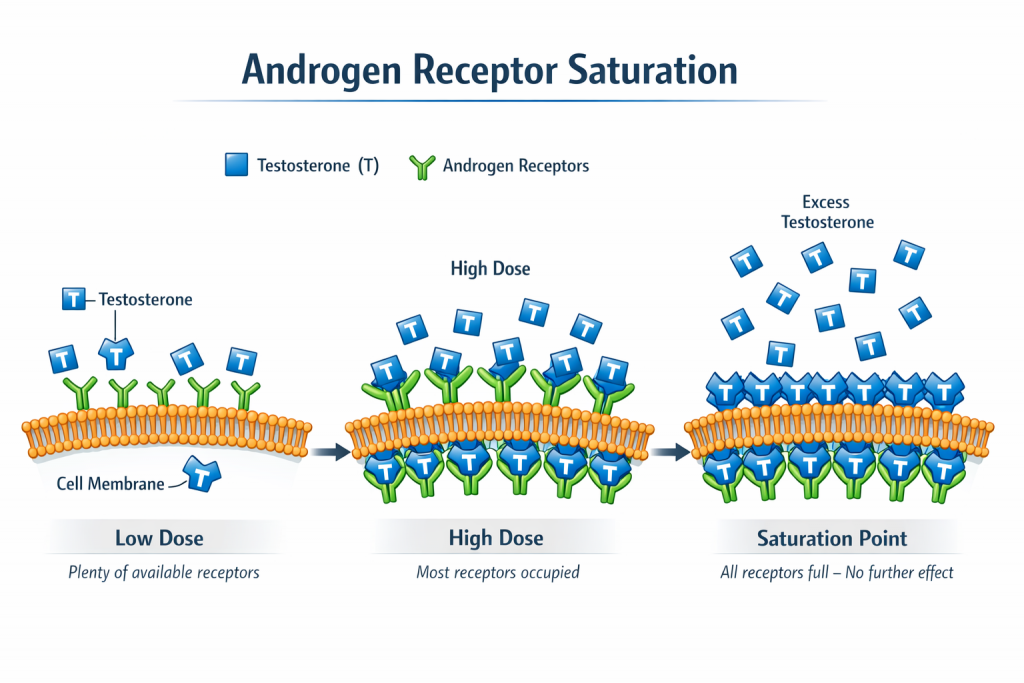
At this point, the limiting factor shifts from hormone concentration to receptor capacity — establishing a physiological ceiling for anabolic response.
Receptor Saturation and Diminishing Returns
As testosterone levels increase, receptor occupancy rises in a nonlinear manner. The dose–response curve follows a characteristic pattern:
- low → physiological range: high responsiveness;
- physiological → moderate supraphysiological: reduced incremental gains;
- high → very high levels: minimal additional effect.
This reflects receptor saturation. When most receptors are already engaged, additional hormone produces progressively smaller increases in downstream signaling. In practical terms, this results in diminishing returns: each increase in dose yields less additional anabolic effect than the previous one.
Biological Adaptation: The Role of Homeostasis
The body is not a passive system — it actively resists imbalance. This regulatory principle is known as homeostasis.
When exposed to chronically elevated testosterone levels, the body initiates adaptive responses to reduce overstimulation. These include:
- downregulation of androgen receptors (reduced sensitivity)
- reduction in receptor density (fewer available receptors)
- increased metabolic clearance of hormones
These mechanisms blunt the response to high androgen levels over time. In effect, the body “normalizes” the signal, making high doses progressively less effective.
This creates a feedback loop where increasing the dose produces less and less additional effect, while pushing the system further away from physiological balance.
Side Effects Continue to Scale with Dose
A critical distinction emerges at higher doses: anabolic effects plateau, while side effects continue to scale with exposure.
Unlike muscle growth, many adverse effects are not limited by receptor saturation and remain dose-dependent.
Dose–Response Divergence
| Parameter | Response to Increasing Dose | Underlying Mechanism | Limiting Factor |
| Muscle growth | Plateaus | Androgen receptor activation | Receptor saturation |
| Strength | Slows / plateaus | Neuromuscular adaptation | CNS + receptor limits |
| Estradiol (aromatization) | Continues to increase | Aromatase-mediated conversion | Not receptor-limited |
| Hematocrit | Increases linearly | Erythropoiesis stimulation | Dose-dependent |
| Lipid profile (HDL ↓) | Worsens with dose | Hepatic lipid metabolism | Dose-dependent |
| Endogenous testosterone | Strong suppression | HPTA negative feedback | Axis inhibition |
This divergence defines the practical limit of dose escalation: beyond a certain point, additional testosterone increases systemic risk more efficiently than it enhances anabolic outcomes.
Why Outcomes Depend on More Than Hormones
Testosterone modulates the anabolic environment but does not independently drive adaptation. Muscle growth is primarily determined by:
- mechanical load (training stimulus);
- nutritional support (energy and protein intake);
- recovery capacity (sleep and systemic stress).
In addition, interindividual variability plays a significant role. Differences in androgen receptor sensitivity, SHBG levels, metabolism, and baseline endocrine status all influence response to the same hormone levels. This explains why identical dosing protocols can produce markedly different outcomes across individuals.
Conclusion
The assumption that higher testosterone doses produce proportionally greater results is based on an incomplete model of androgen physiology.
Anabolic effects are constrained by receptor availability, saturation dynamics, and adaptive regulatory mechanisms. As exposure increases, biological response becomes progressively limited, while dose-dependent side effects continue to accumulate.
Beyond a certain threshold, increasing testosterone does not meaningfully enhance outcomes — it primarily amplifies risk. More testosterone is not a linear path to better results, but a faster approach to physiological limits.